
Approximately 1.5 million Americans per year sustain a brain injury. Of those, 50,000 people will die as a result of brain injury, while 80,000 people per year will experience long-term disabilities as a result of their injury. There are two types of brain injury: traumatic brain injury and acquired brain injury.
Causes of Traumatic Brain Injury
Traumatic brain injury is a result of a direct blow to the head. The force is large enough to break through the skull and damage the soft brain, or to cause the brain to move within the skull.
About 50 to 70 percent of all traumatic brain injuries are the result of car accidents. Other causes include:
- Slips and falls
- Violence
- Sports-related accidents
Causes of Acquired Brain Injury
An acquired brain injury is one that has occurred after birth, and is not hereditary, congenital, or degenerative. Common causes of acquired Brain Injury include:
- airway obstruction
- near drowning
- choking
- injuries in which the chest has been crushed
- electrical shock
- lightning strike
- trauma to the head or neck
- blood loss
- artery impingement
- shock
- heart attack
- stroke
- arteriovenous malformation
- aneurysm
Brain Injury Classifications
Brain injuries are classified as closed or open. A closed head injury is a trauma in which the brain is injured as a result of a blow to the head, or a sudden, violent motion that causes the brain to knock against the skull. Closed head injuries can be diffuse, meaning that they affect cells and tissues throughout the brain; or focal, meaning that the damage occurs in one area. Closed head injuries can range from mild to severe. These brain injuries can cause issues in many places like the occipital lobe or the parietal lobe.
An open head injury, sometimes also called a penetrating head injury, results when an object penetrates the skull and enters the brain. Open head injuries are usually focal, which means that they affect a specific area of brain tissue.
Prognosis of Brain Injury
The prognosis of a brain injury is determined by a variety of factors, including the severity of the damage, the length and the severity of the coma, and the location and the size of any traumas. The more severe the injury, the longer the recovery period. The longer the recover period, the more long-term effects are likely.
Infographic – Football and Brain Injuries: Everything You Need To Know
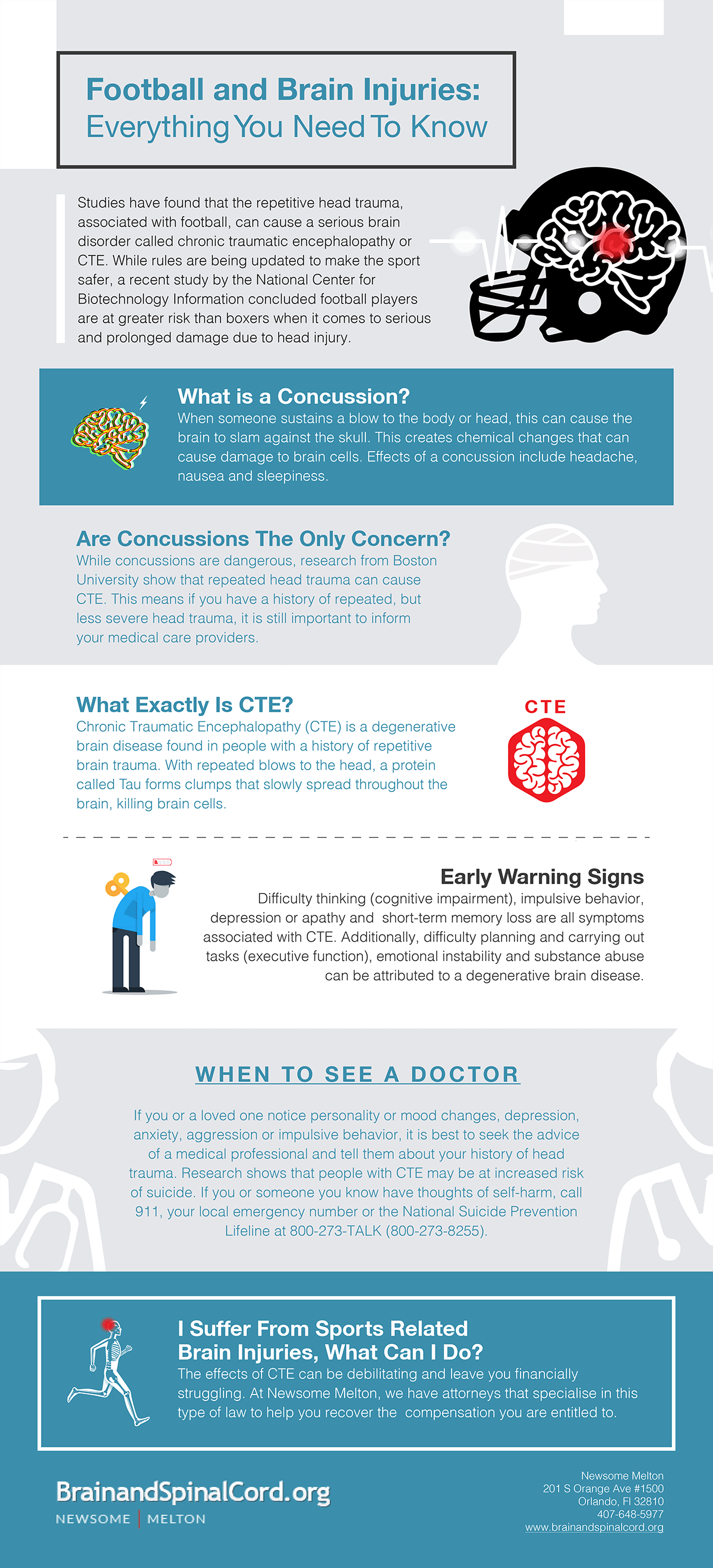
Use the code below to embed and share the infographic on your own site or across the web.
<a target="_blank" href="https://brainandspinalcord.org/brain-injury/"><img src="https://brainandspinalcord.org/wp-content/uploads/2018/10/brain-injury-infographic-by-brain-and-spinalcord-org.png" width="1200" height="2639" alt="Everything You Need to Know about Football and Brain Injuries - Infographic by BrainAndSpinalCord.Org"/></a>